AWS Big Data Development Services
We build large-scale data processing on AWS using Amazon EMR, Hadoop, and Spark, for workloads with the volume, variety, or velocity that a standard serverless pipeline wasn't built to handle.
From cluster architecture through job development and cost tuning, we handle the engineering work behind processing data at a scale where the choice of cluster size, storage layout, and engine actually changes what's possible.

What Is AWS Big Data Development?
AWS big data development is building and running large-scale, distributed data processing on AWS, most commonly using Amazon EMR, AWS's managed Hadoop and Spark platform, for workloads too large, too complex, or too variable in format for a standard serverless pipeline. This covers the classic "big data" problem set: high-volume batch processing, high-velocity event data, and mixed structured and unstructured sources, run on clusters sized and tuned for that specific workload rather than a one-size-fits-all managed job.
"Big data" isn't a term we use to relabel general data engineering. It refers specifically to workloads that need cluster-level control, custom Spark or Hadoop job tuning, multiple processing engines like Hive or Presto on the same dataset, or a scale where serverless services hit their limits. If your workload fits a standard managed pipeline, our AWS data pipeline development and ETL/ELT development services are usually the faster, lower-maintenance option. This page covers the cases where they aren't.
Our AWS big data development services help you:
We size EMR clusters and job configurations around your actual data volume and processing pattern, not a default cluster that's oversized for a light workload and undersized for a heavy one.
AWS Big Data Development Capabilities
Here's what our team delivers, from a first EMR cluster to migrating an existing Hadoop environment onto AWS.
1. Big Data Cluster Architecture
We design the EMR cluster configuration before any job runs on it, sizing node types and counts around your actual processing pattern instead of a default template.
Capabilities
- Core, task, and master node sizing for your workload
- Persistent vs. transient cluster strategy
- Multi-cluster architecture for isolated workloads
- Storage layout using EMRFS and Amazon S3
2. Hadoop & Spark Job Development
We build the distributed processing jobs themselves, tuned for the cluster they'll actually run on rather than generic code that happens to execute.
Capabilities
- Custom Spark job development and performance tuning
- Hadoop MapReduce jobs for workloads that still require them
- Job scheduling and dependency management across a cluster
- Resource allocation tuning to avoid job contention
3. Interactive Big Data Query & Analytics
For teams that need to query massive datasets directly, without waiting on a separate warehouse load, we set up interactive query engines on the same cluster or data.
Capabilities
- Interactive SQL querying with Presto or Trino
- Hive table design and query optimization
- Federated queries across S3, HDFS, and warehouse data
- Query performance tuning for large, complex datasets
4. High-Velocity Data Processing
For the velocity side of big data, streaming and near-real-time volumes too high for a single-purpose streaming service, we build processing on Spark Streaming within EMR.
Capabilities
- Spark Streaming job development on EMR
- High-throughput event processing at scale
- Windowed aggregation and stateful stream processing
- Integration with upstream and downstream data stores
5. Legacy Hadoop Migration to AWS
For teams running an on-premises Hadoop, Cloudera, or Hortonworks environment, we handle the migration to EMR without a lengthy reporting or processing blackout.
Capabilities
- Cluster and job migration from on-prem Hadoop distributions
- HDFS to S3 data migration with validation
- Job and script conversion to EMR-compatible configurations
- Parallel-run testing before cutover
6. Big Data Cost Optimization
Big data clusters are one of the easiest places to overspend without noticing, oversized nodes, clusters left running idle, or on-demand pricing where spot would do. We build against that from the start.
Capabilities
- Spot instance strategy for fault-tolerant workloads
- Auto-scaling policies tied to actual job load
- Transient cluster scheduling to avoid idle compute cost
- Storage tiering between S3 storage classes for processed data
How We Deliver AWS Big Data Development
Structured 5-Stage Engineering Workflow
From workload assessment through cluster sizing, Spark job development, and cost validation, we take end-to-end technical ownership.
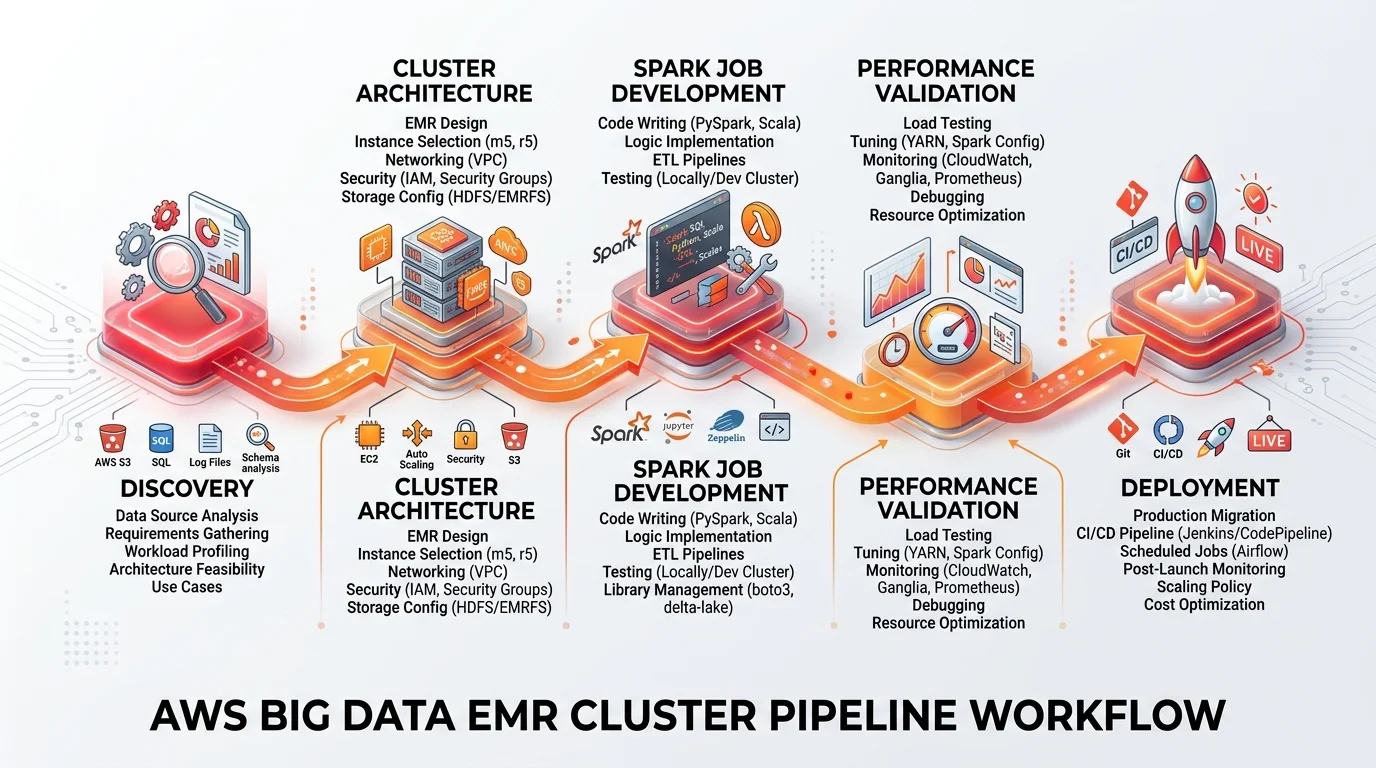
1. Discovery & Workload Assessment
We review your data volume, format variety, processing frequency, and current infrastructure, whether that's an existing AWS setup or an on-prem Hadoop cluster.
2. Cluster & Architecture Design
We design node sizing, storage layout, and persistent vs. transient cluster strategy around your actual workload pattern.
3. Job Development & Tuning
We build and tune the Spark, Hadoop, or Hive jobs themselves, testing against real data volume rather than a small sample set.
4. Performance & Cost Validation
We validate processing performance under production-scale load and confirm cluster cost tracks the sizing we designed for.
5. Deployment, Handover & Support
We deploy with monitoring and cost alerting in place, document the architecture, and hand over, or stay on for ongoing tuning.
AWS Big Data Technologies We Use
Cluster Platform
Processing Engines
Query & Interactive Analytics
Storage
EMR vs. AWS Glue: Choosing the Right Engine
Amazon EMR and AWS Glue both run Spark, and the difference that matters is control versus simplicity. Glue is serverless and managed, a good fit for standard, well-defined ETL jobs. EMR gives you the full Hadoop ecosystem, custom cluster tuning, and multiple engines on one dataset, which matters once a workload's scale or complexity outgrows what a managed job can flex to handle. We'll tell you honestly which one your workload actually needs.
Industries We Build Big Data Solutions For
Healthcare & HealthTech
Large-scale processing for genomic, clinical, and device telemetry data, where dataset size and variety go well beyond standard transactional records.
Fintech & Banking
High-volume transaction and fraud-detection processing that needs cluster-level performance and audit-ready reliability.
SaaS & Technology
Large-scale event and log processing for product analytics, where velocity and volume both push past what a single pipeline was designed for.
E-commerce & Retail
Clickstream and behavioral data processing at a scale where batch windows and query performance both start to matter under peak load.
Enterprise Data Platforms
Consolidated processing across legacy Hadoop environments and modern AWS services, sized for enterprise-wide data volume.
Why Choose Eagle in Cloud for AWS Big Data Development?
Cluster Expertise, Not Just Managed-Service Familiarity
Our team tunes Spark and Hadoop jobs at the cluster level, node sizing, resource allocation, storage layout, not just point-and-click service configuration.
Honest About What You Actually Need
If your workload fits a serverless pipeline instead of a cluster you have to operate, we'll tell you, and point you to the simpler option.
Cost Control Built Into Cluster Design
We default to spot instances and transient clusters where the workload allows, instead of a permanently running cluster nobody's watching the bill on.
Hadoop Migration Experience
We've moved on-premises Hadoop and Cloudera environments onto EMR without a reporting blackout, not just built greenfield clusters.
End-to-End Delivery
From cluster architecture to job development, tuning, and cost optimization, we own the full build, or plug into your existing data team.
Frequently Asked Questions
Still have questions? We are here to help you.
Ask a Big Data EngineerRelated AWS Data Engineering Services
Ready to Process Data at a Scale Standard Pipelines Can't Handle?
Let's build a cluster architecture sized for your actual data volume, not a default configuration that's either too small or quietly expensive.