AWS Workflow Orchestration Services
We design the orchestration layer that runs your pipeline steps in the right order, retries the ones that fail, and tells someone when a step fails anyway, built entirely on AWS-native services.
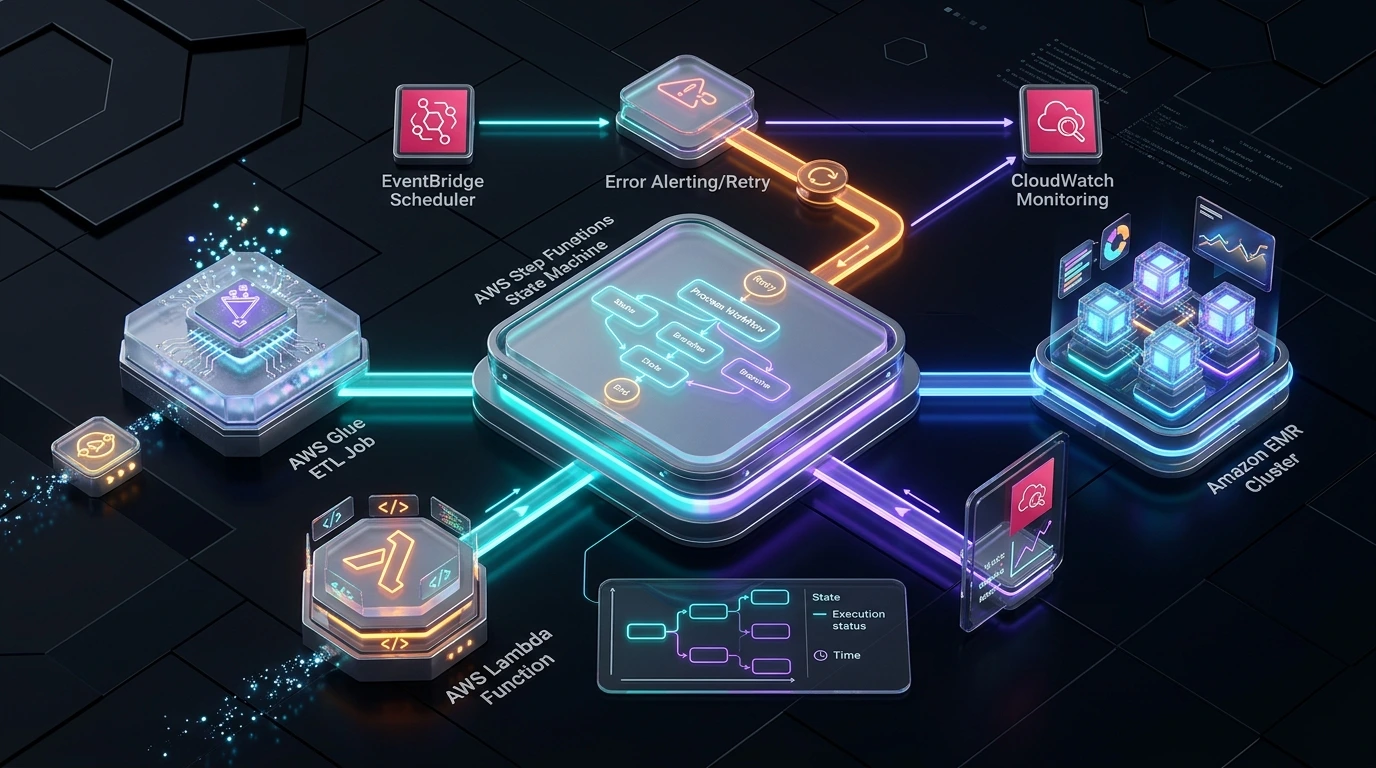
No separate scheduler to host, patch, or scale. We coordinate Glue jobs, Lambda functions, EMR steps, and database loads using Step Functions and EventBridge, so the orchestration logic lives in the same account and scales the same way the rest of your pipeline does.
What Is AWS Workflow Orchestration?
AWS workflow orchestration is the coordination layer that decides what order your pipeline steps run in, what happens when one of them fails, and how dependencies between services get managed, built using AWS Step Functions and Amazon EventBridge rather than a separately hosted scheduler. Step Functions defines the workflow itself as a state machine, with each step, retry, and failure path spelled out explicitly. EventBridge handles the triggering side, starting workflows based on events, schedules, or changes elsewhere in your AWS account.
Orchestration is usually one piece of a larger pipeline project, not the whole thing. If you need the pipeline steps themselves built too, ingestion, transformation, loading, see our AWS data pipeline development services, which this page's orchestration work is often scoped alongside.
Our AWS workflow orchestration services help you:
We build orchestration entirely on managed AWS services, so there's no scheduler cluster to size, patch, or keep available, the orchestration layer scales the same way the rest of your AWS account does.
AWS Workflow Orchestration Capabilities
Here's what our team delivers, from a single multi-step workflow to orchestration spanning your entire pipeline estate.
1. Step Functions Workflow Design
We design the state machine itself, the sequence, branching logic, and parallel execution paths, before writing any step's underlying code.
Capabilities
- State machine design for sequential, parallel, and branching workflows
- Standard vs. Express workflow selection based on duration and volume
- Input/output data passing between workflow steps
- Nested and modular state machine design for complex pipelines
2. Event-Driven Triggering & Scheduling
We build the triggering layer that starts workflows automatically, on a schedule, in response to an event, or when an upstream process completes.
Capabilities
- Scheduled workflow triggering with EventBridge Scheduler
- Event-driven triggering from S3, database changes, or custom events
- Cross-account and cross-service event routing
- Conditional triggering based on event content
3. Cross-Service Pipeline Coordination
Most pipelines span more than one AWS service. We build the orchestration that coordinates them as a single, reliable workflow instead of a set of independently scheduled jobs hoping to line up.
Capabilities
- Coordinating Glue jobs, Lambda functions, and EMR steps in one workflow
- Dependency management between services with different run times
- Conditional branching based on upstream job results
- Coordination across multiple AWS accounts
4. Error Handling, Retries & Failure Recovery
A workflow that fails silently is worse than one that fails loudly. We build retry logic and failure paths in from the start, not as an afterthought once something breaks in production.
Capabilities
- Automatic retry logic with configurable backoff
- Catch and fallback paths for failed steps
- Dead-letter handling for repeatedly failing executions
- Failure alerting routed to the right team, not a shared inbox nobody checks
5. Scheduling & Dependency Management
For pipelines with real dependencies between steps, some daily, some hourly, some waiting on another team's job, we build the scheduling logic that respects those constraints.
Capabilities
- Multi-job dependency chains across different schedules
- Handling for jobs that must wait on external or third-party data
- Backfill and reprocessing workflow design
- SLA-aware scheduling for time-sensitive pipelines
6. Monitoring & Observability
Once a workflow is running in production, you need to see what happened, not just that something did. We build visibility into every execution.
Capabilities
- Execution history and step-level tracing
- Custom dashboards for workflow health and duration
- SLA and duration alerting for time-sensitive pipelines
- Audit logging for compliance-sensitive workflows
How We Build AWS Workflow Orchestration
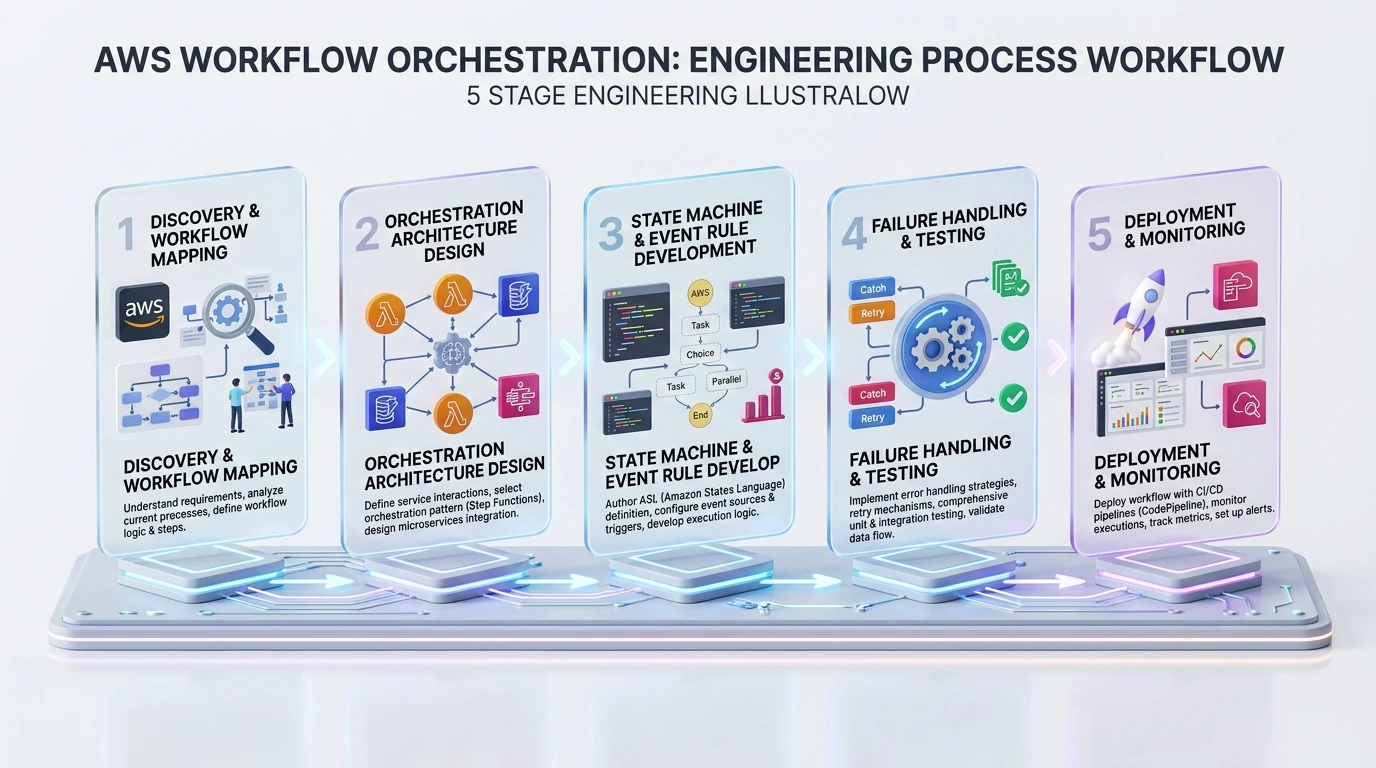
Structured 5-Stage Orchestration Workflow
From initial workflow mapping through state machine development, failure testing, and production monitoring, we build resilient coordination layers.
1. Discovery & Workflow Mapping
We map your current pipeline steps, dependencies, and failure points, including where things break today and how failures currently get noticed.
2. Orchestration Architecture Design
We design the state machine structure and event triggering approach around your actual dependency chain, not a generic template.
3. State Machine & Event Rule Development
We build the Step Functions state machines and EventBridge rules, with retry and failure paths defined alongside the happy path.
4. Failure Handling & Testing
We test failure scenarios deliberately, a job timing out, a step returning bad data, to confirm the workflow degrades the way it's supposed to.
5. Deployment & Monitoring
We deploy with execution tracing and alerting in place, so a failed run gets noticed and routed to the right person automatically.
AWS Workflow Orchestration Technologies We Use
Orchestration Core
Coordinated Services
Alerting & Messaging
Monitoring
Step Functions & EventBridge
Step Functions and EventBridge solve different parts of the same problem. Step Functions defines the workflow itself, the steps, order, and failure paths, as an explicit state machine. EventBridge handles what starts that workflow and how services react to events elsewhere in your account. Most orchestration architectures need both: EventBridge to trigger and route, Step Functions to run the actual sequence.
Industries We Build Workflow Orchestration For
Healthcare & HealthTech
Orchestration for compliance-sensitive pipelines where every step needs an audit trail and every failure needs to be caught, not silently skipped.
Fintech & Banking
Reliable sequencing for reconciliation and reporting workflows where a step running out of order produces a wrong number, not just a late one.
SaaS & Technology
Orchestration that scales with usage automatically, without a scheduler cluster someone has to size ahead of growth.
E-commerce & Retail
Workflow coordination for order, inventory, and reporting pipelines that has to hold up during peak traffic, not just steady-state load.
Enterprise Data Platforms
Cross-account, cross-service orchestration that coordinates pipelines spanning multiple business units and legacy systems.
Why Choose Eagle in Cloud for AWS Workflow Orchestration?
Failure Paths Designed First
We build retry logic and failure handling alongside the happy path, not as a patch after a workflow fails silently in production.
Nothing Extra to Host
Orchestration runs entirely on managed AWS services, no scheduler server or cluster for your team to size, patch, or keep available.
Cross-Service Depth
We coordinate Glue, Lambda, EMR, and database loads in one workflow, not just simple two-step chains.
Visibility Built In
Every workflow we build ships with execution tracing and alerting, so failures get noticed and routed automatically.
End-to-End Delivery
From workflow mapping to state machine development, testing, and deployment, we own the full build, or plug into your existing data team.
Frequently Asked Questions
Still have questions? We are here to help you.
Talk directly with an AWS orchestration engineer about your specific pipeline needs.
Ask an Orchestration EngineerRelated AWS Data Engineering Services
Ready for Pipelines That Fail Loudly Instead of Silently?
Let's build orchestration that catches a failed step before your stakeholders do, on services you don't have to host or patch yourself.