AWS Data Governance Services
We build the governance layer that sits across your data lake, warehouse, and platforms, one catalog, one classification model, one place to see who can access what and where a number actually came from.
Every AWS service you use for storage or compute has its own access controls. What most organizations are missing isn't another set of permissions, it's the layer that makes those controls consistent, documented, and enforceable as policy across all of them at once.

What Is AWS Data Governance?
AWS data governance is the practice of defining and enforcing consistent policy, classification, access control, and lineage tracking across every data store an organization runs on AWS, rather than managing each system's permissions and cataloging separately. On AWS, this is increasingly built on Amazon SageMaker Unified Studio and its underlying Amazon SageMaker Data and AI Governance capabilities, powered by Amazon DataZone, which provide a single catalog and permission model spanning services like Glue, Redshift, Athena, and EMR instead of a separate governance setup per service.
This is different from the platform-level access controls we build as part of other projects. Our AWS data lake development, Databricks, and Snowflake services each include governance and access control specific to that one platform. This page covers the layer above that: the framework, catalog, and policy model that ties those platform-level controls together into one governed system instead of several disconnected ones.
Our AWS data governance services help you:
We design the governance framework first and implement the tooling to enforce it, not the other way around, so the policy reflects how your organization actually works before it gets encoded into permissions.
AWS Data Governance Capabilities
Here's what our team delivers, from a first governance framework to full cross-platform catalog and policy implementation.
1. Data Governance Strategy & Framework Design
Before any tooling gets configured, we define what governance actually means for your organization: who owns what data, who approves access, and what "compliant" looks like in practice.
Capabilities
- Data ownership and stewardship model design
- Governance policy and standards documentation
- Roles and responsibilities across data producers and consumers
- Governance operating model sized to your organization's structure
2. Enterprise Data Cataloging
We implement a catalog that spans your entire AWS data estate, so "what data do we have and where" has one answer instead of one answer per system.
Capabilities
- Unified catalog across Glue, Redshift, Athena, and EMR data sources
- Business glossary and metadata form design
- Semantic search and dataset discovery for data consumers
- Publish and subscribe workflows for data producers and requesters
3. Data Classification & Sensitivity Labeling
You can't govern what isn't labeled. We build the classification layer that flags sensitive data consistently, before it becomes a compliance question during an audit.
Capabilities
- PII, PHI, and sensitive data classification policy
- Automated and manual classification workflows
- Consistent labeling across structured and unstructured data
- Classification-aware access policy design
4. Cross-Platform Access Policy
We design one access policy model that spans your data stores, then coordinate it with the platform-level controls each system already enforces.
Capabilities
- Single permission model design across multiple data platforms
- Subscription and approval workflows for data access requests
- Policy reconciliation across existing platform-level controls
- Access review and recertification processes
5. Data Lineage & Audit Trail
We implement lineage that traces a dataset from source through every transformation to where it's consumed, across systems, not just within a single pipeline.
Capabilities
- End-to-end, column-level lineage across data sources
- Cross-system lineage spanning lake, warehouse, and platform boundaries
- Audit logging for access and data movement events
- Lineage documentation for compliance and dispute resolution
6. Compliance & Regulatory Readiness
We build governance documentation and controls that hold up when an auditor asks for them, not just a policy binder nobody's opened since it was written.
Capabilities
- Governance alignment with HIPAA, GDPR, CCPA, and SOC 2 requirements
- Data retention and deletion policy design
- Audit-ready documentation and control evidence
- Ongoing compliance monitoring and reporting
How We Build AWS Data Governance
Structured 5-Stage Governance Engineering Workflow
From maturity assessment and policy design through cataloging, access control, and team rollout, we implement governance that works in practice.
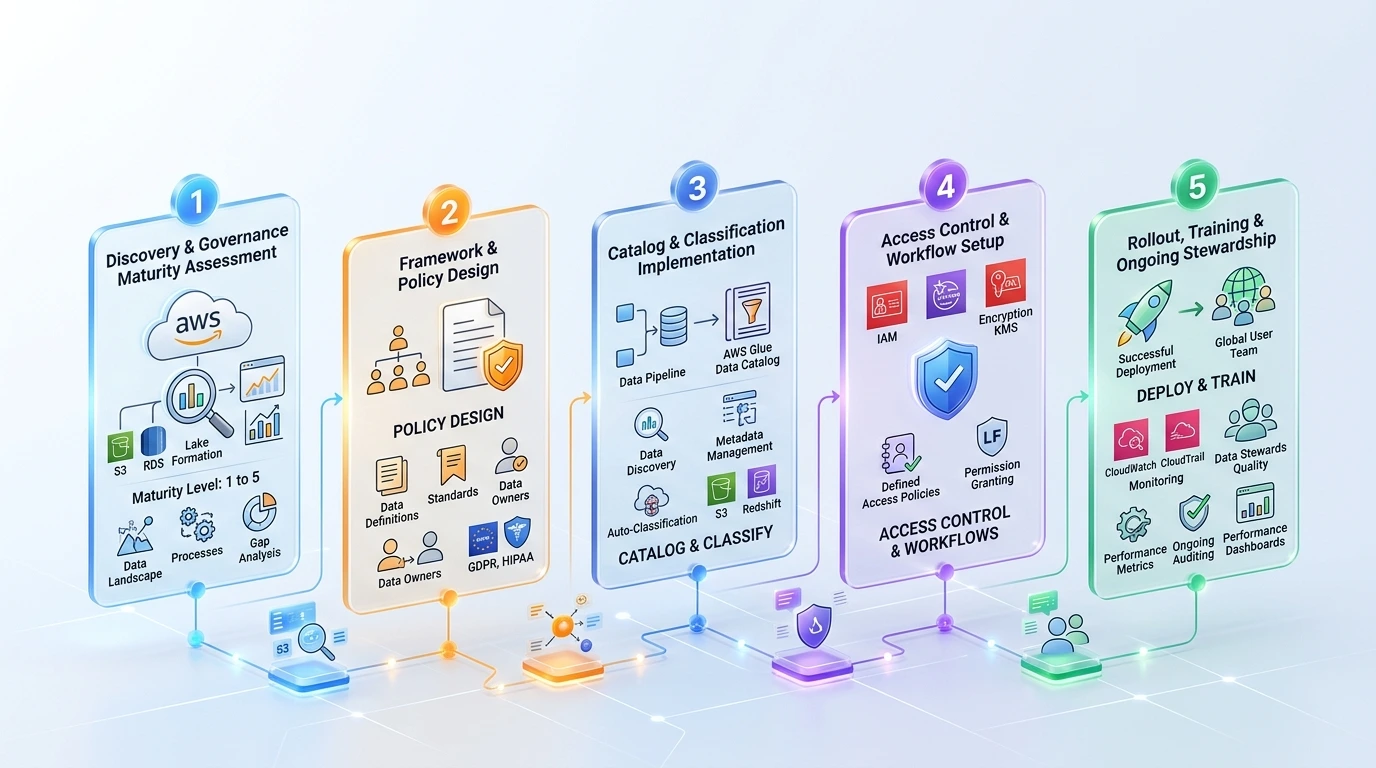
1. Discovery & Governance Maturity Assessment
We assess your current state, how data is classified, who has access to what, and where governance is inconsistent or undocumented across systems.
2. Framework & Policy Design
We define ownership, stewardship roles, and policy standards before configuring any tooling, so the framework reflects how your organization actually operates.
3. Catalog & Classification Implementation
We implement the unified catalog and classification model, bringing datasets from across your AWS estate into one governed view.
4. Access Control & Workflow Setup
We implement the access policy model and coordinate it with existing platform-level controls, so requests, approvals, and reviews run through one process.
5. Rollout, Training & Ongoing Stewardship
We roll out the governance program to your teams, document it clearly, and support the stewardship model so it holds up after we hand over.
AWS Data Governance Technologies We Use
Cataloging & Governance Platform
Platform-Level Access Controls
Lineage & Data Quality
Audit & Compliance
Amazon DataZone & SageMaker Unified Studio
Amazon DataZone is the underlying engine, and Amazon SageMaker Unified Studio is where your teams actually work day to day, catalog browsing, access requests, lineage views, all in one place instead of scattered across each service's own console. We implement governance at this layer specifically because it's the one place policy can apply consistently, whether the data lives in S3, Redshift, Databricks, or Snowflake.
Industries We Build Data Governance For
Healthcare & HealthTech
Governance frameworks built for HIPAA-aligned classification and access control across clinical, claims, and operational data.
Fintech & Banking
Audit-ready governance for regulated reporting, with access reviews and lineage that hold up under regulatory examination.
SaaS & Technology
Governance that scales with a growing data estate, without creating approval bottlenecks that slow product and analytics teams down.
E-commerce & Retail
Classification and access policy for customer and transactional data that meets PCI and privacy requirements without slowing reporting.
Enterprise Data Platforms
Cross-business-unit governance that gives a large organization one catalog and one policy model instead of governance decisions made independently by every team.
Why Choose Eagle in Cloud for AWS Data Governance?
Framework First, Tooling Second
We define ownership, policy, and stewardship roles before configuring any catalog or permission model, so governance reflects your organization, not a default template.
Cross-Platform by Design
We build governance that spans your lake, warehouse, and platforms as one system, not a separate policy document per service that drifts out of sync.
Audit-Ready, Not Just Documented
Our compliance work produces evidence an auditor can actually use, not a policy binder that exists but was never operationalized.
Practical Stewardship, Not Just Policy
We build governance programs your teams follow day to day, with workflows for requests and reviews, not rules that live only in a document.
End-to-End Delivery
From framework design to cataloging, classification, access policy, and compliance readiness, we own the full build, or plug into your existing data team.
Frequently Asked Questions
Still have questions? We are here to help you.
Talk directly with an AWS data governance architect about your organization's compliance and cataloging requirements.
Ask a Governance ArchitectRelated AWS Data Engineering Services
Ready for One Catalog Instead of Five?
Let's build a governance layer that spans your entire AWS data estate, so access, classification, and lineage have one answer, not one per system.